People
J. MICHAEL. BISHOP (1936-2026)
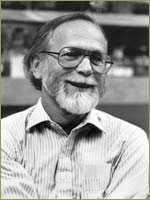
He arrived at UCSF in 1968, hired as an assistant professor of microbiology and immunology, and continued work in virology with Leon Levintow, who had joined the UCSF faculty two years earlier. Bishop became a full professor in 1972 and, in 1981, was appointed director of the G. W. Hooper Research Foundation. In the mid-1980s, he also became director of the Program in Biological Sciences (PIBS), a pathbreaking interdisciplinary graduate education program.
As he developed his research program, Bishop began studying retroviruses and utilized reverse transcriptase to explore viral DNA. In 1970, Harold E. Varmus joined Bishop as a postdoctoral fellow, and Bishop recalls, "Our relationship evolved rapidly to one of coequals, and the result was surely greater than the sum of the two parts". Over the next two decades, Bishop and Varmus identified and clarified the process by which Rous Sarcoma Virus transforms normal cellular genes (proto-oncogenes) into cancer genes (oncogenes). In 1989, Bishop and Varmus were awarded the Nobel Prize in Physiology or Medicine for the discovery that growth-regulating genes in normal cells can malfunction and initiate the abnormal growth processes of cancer. Bishop is the recipient of numerous awards in addition to the Nobel Prize, including the Albert Lasker Award for Basic Biomedical Research and the American Cancer Society National Medal of Honor. In 2003, he was awarded the National Medal of Science.
On July 1, 1998, J. Michael Bishop became the eighth chancellor of UCSF, and presided over what would become the largest academic biomedical expansion in the nation — the creation of the UCSF Mission Bay campus. Mission Bay formally opened in 2003 and, by 2008, included four research buildings (Genentech Hall, Rock Hall, Byers Hall, and the Diller Cancer Research Building) and the William J. Rutter Center. Bishop retired as UCSF Chancellor in August 2009, with the distinction of the longest term of service in that office. Michael Bishop, Nobel-Winning Cancer Researcher, Has Died at 90.
For a lively autobiographical account of Dr. Bishop's life and work, see How to Win the Nobel Prize: An Unexpected Life in Science (Cambridge Mass. & London, England: Harvard University Press, 2003).
